A steam turbine is both a thermal power device and a high-speed rotating machine. Therefore, in addition to monitoring conventional thermal parameters (temperature, pressure, and vacuum), mechanical parameters must also be monitored to understand the turbine's mechanical operating conditions. These parameters include rotor axial displacement, relative expansion between the rotor and cylinder, absolute expansion of the cylinder, bearing vibration, rotor bending, and turbine speed. Unlike conventional thermal parameter measurements, the measurement and monitoring of these mechanical parameters requires specialized equipment: turbine supervisory instruments (
TSI systems).
The reliability of a steam turbine's operation is largely determined by the unit's vibration profile. Excessively strong vibration indicates a serious defect. Vibration can loosen connections between internal components, weakening the rigidity of the connections between the cylinder, bearing housing, baseplate, and foundation, which in turn exacerbates unit vibration.
1. Absolute Vibration Measurement of Steam Turbine Shafts
Since the turbine bearings, bearing seats, and base are not rigidly connected, elasticity and damping factors exist. This causes some shaft vibration to be transmitted to the bearings and bearing seats. Therefore, measuring the vibration of the shaft relative to the bearings does not truly reflect the actual vibration condition of the shaft. Therefore, the requirement for measuring bearing pad vibration has been proposed. Pad vibration is also known as bearing seat vibration, also called bearing vibration. This is typically measured using a contact-type velocity or acceleration sensor, typically fixed directly to the bearing cap, and is sometimes also called shell vibration or cap vibration. Pad vibration is typically measured vertically or at a 45° angle to the midplane, with horizontal measurement being less common.
2. Two Common Absolute Vibration Monitoring Principles
1.
Piezoelectric Sensors
The mechanical receiving portion of a piezoelectric accelerometer follows the inertial acceleration mechanical receiving principle, while the electromechanical portion utilizes the direct piezoelectric effect of a piezoelectric crystal. The principle is that certain crystals (such as artificially polarized ceramics and piezoelectric quartz crystals)—different piezoelectric materials have different piezoelectric coefficients, which can generally be found in piezoelectric material performance tables—generate electric charges on their crystal faces or polarization surfaces when subjected to a specific external force or deformation. This conversion of mechanical energy (force, deformation) into electrical energy (charge, electric field) is called the direct piezoelectric effect. The conversion of electrical energy (electric field, voltage) into mechanical energy (deformation, force) is called the inverse piezoelectric effect.
Thus, the piezoelectric effect of crystals can be used to create force sensors. In vibration measurement, since the force acting on the piezoelectric crystal is the inertial force of the inertial mass, the charge generated is proportional to the magnitude of the acceleration. Therefore, piezoelectric sensors are acceleration sensors.
2.
Velocity Sensors
Inertial electric sensors consist of a fixed part, a movable part, and a supporting spring. For the sensor to operate as a displacement sensor, the mass of its movable part must be sufficiently large, while the stiffness of the supporting spring must be sufficiently small, which means that the sensor has a sufficiently low natural frequency.
According to the law of electromagnetic induction, the induced electromotive force is: u = B × L × v × sinA
where B is the magnetic flux density, L is the effective length of the coil within the magnetic field, and v × sinA is the relative velocity of the coil within the magnetic field.
In terms of sensor structure, an inertial electromotive force sensor is a displacement sensor. However, since its output signal is generated by electromagnetic induction, according to the law of electromagnetic induction, when the coil moves relative to the magnetic field, the induced electromotive force is proportional to the velocity at which the coil cuts the magnetic lines of force. Therefore, the sensor's output signal is proportional to the measured vibration velocity, hence the name velocity sensor.
3. Comparison and Analysis of Two VM600 Watt Vibration Sensors
Vibero-meter's VM600 series TSI products are currently primarily used in combined cycle units, ultra-supercritical units, and nuclear power turbines. This article focuses on two VM vibration sensors, the
CA202 and
CV213.
The CA202 is a piezoelectric accelerometer featuring a symmetrical shear-type polycrystalline measuring element, an insulated inner housing, and a transducer designed for heavy-duty industrial vibration monitoring and measurement. The accelerometer is equipped with an integral cable protected by a flexible stainless steel tube welded to the outer housing.
The CV213 is a magnetoelectric velocity sensor. The sensor's sensing element consists of a coil moving around a permanent magnet. This assembly generates a voltage proportional to the vibration velocity, generating a signal without the need for an external power source, making these devices suitable for portable measurement applications.
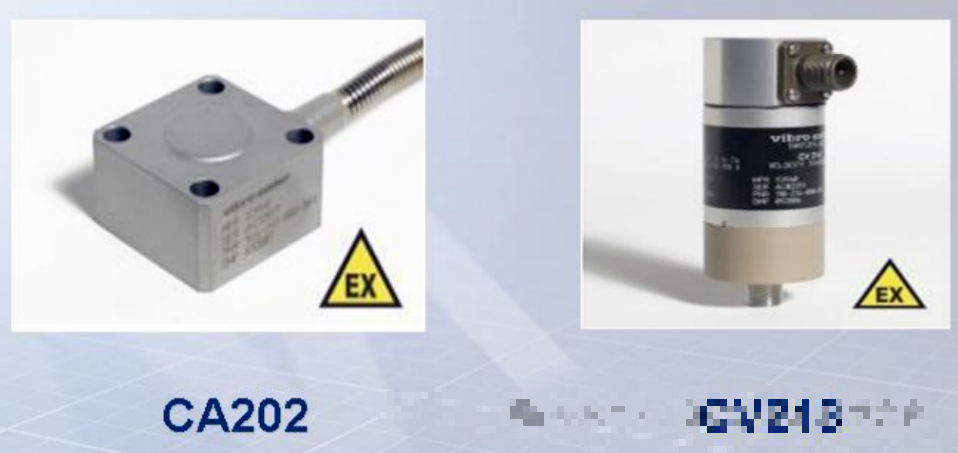
Figure 1 CA202 probe and CV213 probe
1. Introduction to the Design Parameters of the Two Probes
CA202 Probe
-
Piezoelectric Accelerometer
-
Generates a charge signal with a sensitivity of 100 pc/g (commonly used)
-
Requires an IPC707 preamplifier
-
Probe overview is shown in the figure:
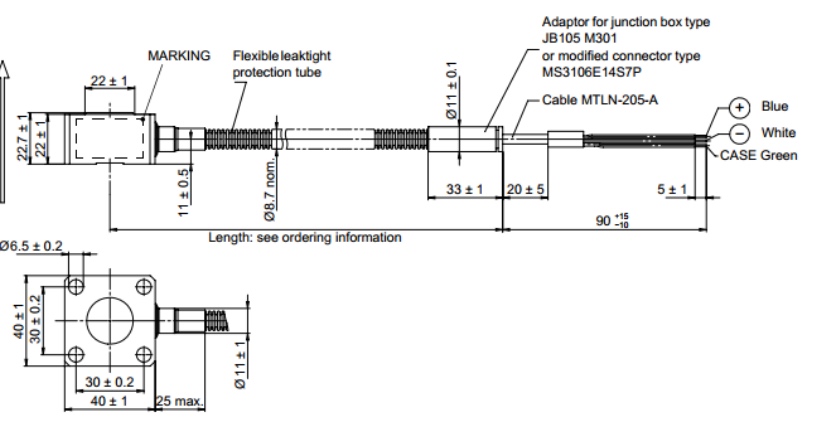
Figure 2 CA202 Probe
CV213 Probe
-
Velocity Sensor
-
Generates a voltage signal with a sensitivity of 20 mV/mm/s
-
No power supply or preamplifier required.
-
Uses 1/2"-20 UNF studs for installation.
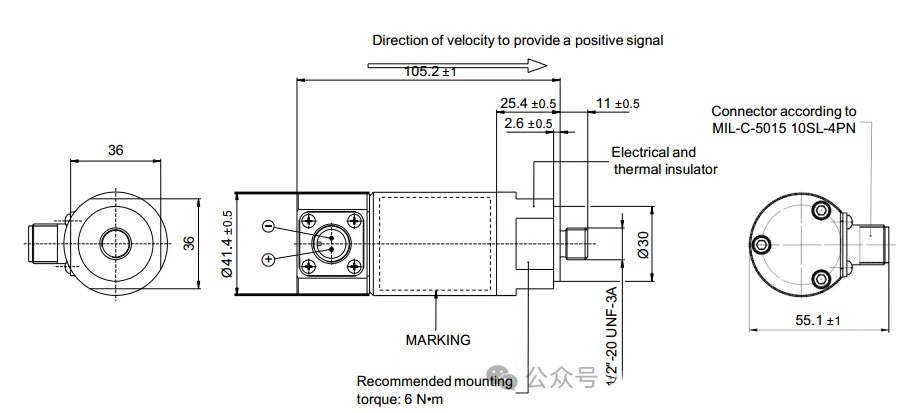
Figure 3 CV213 Probe
2. Sensor Type
-
CA202 is a piezoelectric accelerometer with a sensitivity of 100 pc/g (commonly used)
-
CV213 is a velocity sensor with a sensitivity of 20 mV/mm/s
Existing combined cycle steam turbines and ultra-supercritical thermal power units all use velocity signals (mm/s) for protection. The CA202 requires a preamplifier to integrate the acceleration signal into a velocity signal and send it to the secondary instrumentation. The CV213 provides the velocity signal directly, eliminating the need for secondary relays.
3. Operating Parameters
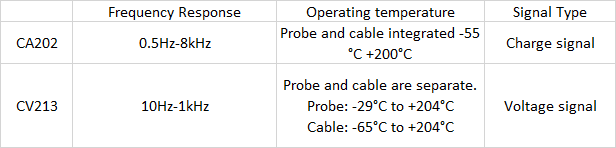
Figure 4 Operating Parameters
-
Frequency Response: The frequency response range of the CA202 is much wider than that of the CV213.
-
Temperature: There is no difference between the two.
4. Measurement Link
CA202: Sensor (CA202) - Preamplifier (
IPC704) - Secondary Instrument
CV213: Sensor (CV213) - Cable - Secondary Instrument
The CA202 signal must be sent to the IPC704 for integration.
CA202 Wiring:
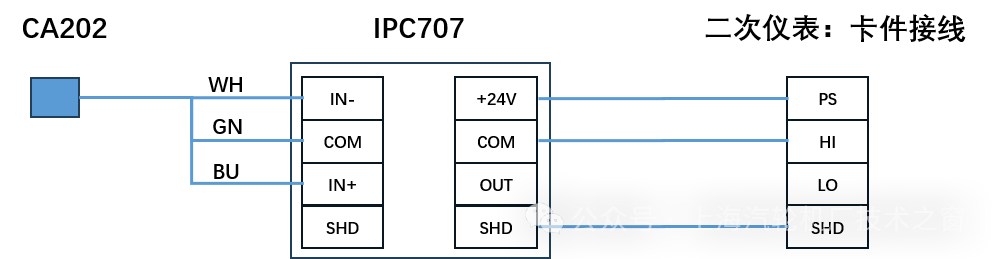
Figure 5: CV202 Wiring Diagram
CV213 Wiring: When configuring the CV213, the HI terminal carries 27V and powers the probe; connect + to HI and - to LO.
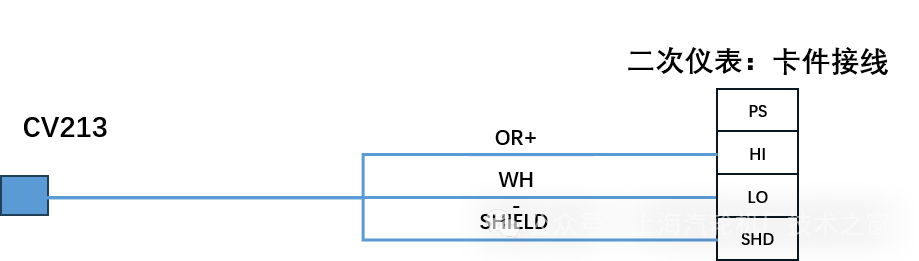
Figure 6: CV213 Wiring Diagram
5. Sensor Installation
The CA202 uses four screws to secure the sensor in its four positions;
the CV213 uses a single stud.
Comparison:
-
Sensor Fixing: The CA202's fixing method is more secure than the CV213's. However, since it uses four screws, uneven thermal expansion at the installation location can cause uneven force on the four screws, potentially compressing the sensor, generating signals, and affecting measurements. Therefore, during installation, the tightening torque specified in the device catalog should be .
-
Cable Fixing: The CA202 uses a charge signal, and the cable acts as a capacitor. Therefore, strict requirements are placed on cable curvature and fixing spacing to prevent cable sway and tight bends.