3. 3500/20 Frame Interface Module:
The Frame Interface Module (RIM) is the basic interface for the 3500 frame. It supports Bentley Nevada's proprietary protocols for frame configuration and retrieving information from the unit. The Frame Interface Module must be placed in the first slot of the frame (closest to the power supply). The RIM can connect to compatible Bentley Nevada communication processors such as TDXnet, TDIX, and DDIX. While the RIM provides some general functionality for the entire frame, it is not part of the critical monitoring path and has no impact on the correct and normal operation of the overall monitoring system. One Frame Interface Module is required for each frame.
It has an RS-232 serial interface on its front panel for connecting to the host for data acquisition and frame configuration. The maximum baud rate is 38.4K, and the maximum cable length is 30m. The rear I/O (input/output) modules have RS-232/RS-422 serial interfaces, which can also connect to the host for data acquisition and frame configuration. The maximum baud rate is 38.4K, and the cable length is 30m for RS232 and 1200m for RS422. The RS422 interface also allows multiple 3500 frames to be daisy-chained together for communication with the 3500 host software.
Meanings of LEDs (Light Emitting Diodes) on the Front Panel:
OK LED: Flashes when the frame interface module is operating normally;
TX/RX LED: Flashes when the RIM is communicating with other modules in the 3500 frame;
TM LED: Flashes when the 3500 frame is in alarm multiplication mode;
CONFIG OK LED: Flashes when the 3500 frame is configured correctly.
Front Panel Hardware Switches:
Frame Reset Button: Clears locked alarms and timed OK failures. Has the same function as the "Frame Reset" contact on the input/output module.
Address Switch: Used to set the frame address. There are 63 selectable addresses.
Configuration Key Lock: Used to set the 3500 frame to "RUN" or "PROGRAM" mode. RUN mode allows normal frame operation and locks any configuration changes. PROGRAM mode allows normal frame operation and allows remote or local configuration of the frame. The key can be freely rotated between two positions within the frame, allowing the switch to remain in either the RUN or PROGRAM position. Locking to RUN mode prevents any unauthorized frame configuration. Locking to PROGRAM mode allows for remote configuration of the frame at any time.
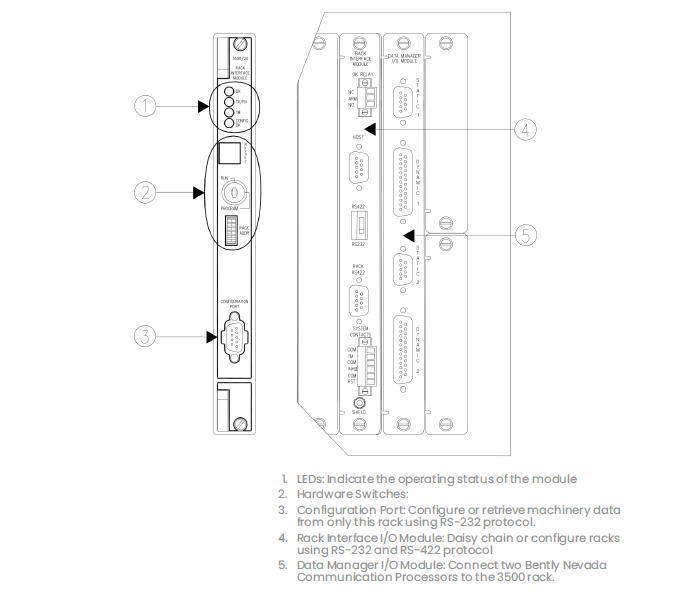
1) LED: Displays the module's operating status;
2) Hardware switch;
3) Configuration port: Uses the RS-232 protocol to configure or retrieve mechanical data from the frame;
4) Frame interface I/O module: Uses RS-232 and RS-422 communication protocols to connect to or configure the frame in a daisy-chain configuration;
5) Data manager system I/O module: Connects two Bentley Neva communication processors to the 3500 frame.
4. 3500/22 Transient Data Interface
The 3500 Transient Data Interface (TDI) is the interface between the 3500 monitoring system and Bentley Nevada System 1™ Machinery Management software. The TDI combines the functionality of the 3500/20 frame interface module (RIM) and a communication processor, such as TDXnet. The TDI operates in the RIM slot of the 3500 frame and works with M-series monitors (3500/40M, 3500/42M, etc.) to continuously acquire steady-state and transient waveform data and transmit the data to the host computer software via Ethernet. The TDI features standard static data acquisition, but with an optional channel-enabled disk, it can also acquire transient or dynamic data. Compared to previous communication processors, the TDI offers several improvements besides integrating the communication processor's functionality into the 3500 frame.
The TDI provides general functionality for all frames but is not a component of critical monitoring channels and does not affect the correct and normal operation of the overall monitoring system. Each frame requires one TDI or RIM. The TDI occupies only one slot in the frame and must be located in the first slot (adjacent to the power module).
For Triple Module Redundancy (TMR) applications, the 3500 system requires a TDI in TMR form. In addition to all the functions of a standard TDI, the TMR TDI also features a "monitor channel comparison function." By selecting the monitor option during installation, the 3500TMR configuration performs the monitoring voting function. In this way, the TMR TDI continuously compares the outputs of three redundant monitors. If the TMR TDI detects that the output information of one monitor is not equal to that of the other two monitors (within the configured percentage), it issues an error indication to the monitor and adds an event to the system event list.
The purpose of the LEDs on the front panel of the module and the various hardware toggle switches are the same as those on the 3500/20, except that its address selection switch has 127 address options. The interface on the rear panel is shown in the following figure:
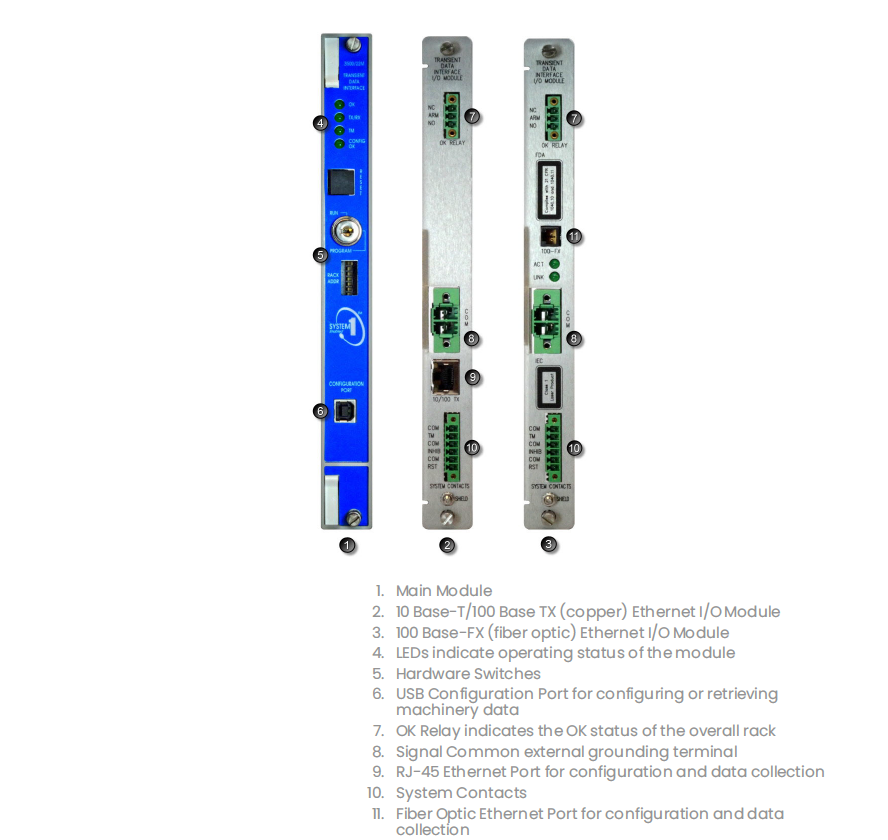
1) Main Module
2) 10/100Base-T Ethernet Input/Output Module, RJ-45 (telephone jack type) for 10Base-T/100Base-TX Ethernet cable, maximum cable length 100m;--146031-01
3) 100Base-FX Ethernet Input/Output Module, MT-RJ fiber optic connector, 100Base-FX cable, maximum 400 meters (1312 feet) multimode fiber optic cable;--146031-02
4) LED: Indicates module operating status
5) Hardware Switch
6) Configuration Port: Uses RS-232 protocol for configuring or retrieving machine data
7) OK Relay: Indicates the OK status of the frame
8) Fiber Optic Ethernet Port: Used for configuration and data acquisition
9) RJ45 Ethernet Port: Used for configuration and data acquisition
10) System Contacts
5. 3500/25 Keyphase Module
The improved 3500/25 keyphase module is a half-height, 2-channel module used to provide keyphase signals to the monitor module within the 3500 frame. This module receives input signals from eddy current or electromagnetic sensors and converts these signals into digital keyphase signals, indicating when a keyphase marker on the shaft passes through a keyphase probe. Each keyphase module has two input channels, and the 3500 mechanical protection system can accommodate two keyphase modules, receiving four keyphase signals.
Note: Keyphase signals are pulse signals from a rotating shaft or gear, occurring once or multiple times per revolution, providing precise timing measurements. This allows the 3500 monitor module and external diagnostic equipment to measure vector parameters such as 1X amplitude and phase.
Each keyphase module can receive two signals from eddy current or electromagnetic sensors. The input signal range is -0.8V to -21.0V (non-isolated I/O modules) and +5V to -11V (isolated I/O modules). Limiting is possible within the module to prevent the signal from exceeding this range. Passive electromagnetic sensors require a shaft speed greater than 200 rpm (3.3Hz). Two buffered keyed-phase output signals are located on the front panel of the frame via coaxial connectors. Two buffered keyed-phase outputs are also available on the rear panel of the frame via European connectors. The front panel LED OK indicator indicates a fault detected within the key phase module. The TX/RX indicator provides indication when the key phase module is communicating with the frame interface module (RIM).
The following diagram shows the front view of the key phase module and the rear view of several different types of I/O modules. 1) Buffered sensor output
2) I/O module, insulated internal terminals-125800-01
3) I/O module, insulated external terminals-126648-01
4) I/O module, non-insulated internal terminals-125800-02
5) I/O module, non-insulated external terminals-126648-02
6) I/O module with safety barrier, internal terminals-135473-01
Address : Unit 1904, No.96-2 Lujiang Road, Siming District, Xiamen
Phone/WhatsApp/Skype : +86 18060982349
E-mail : sales6@nseauto.com