In the majority of supercritical and subcritical units at turbine manufacturing plants, relative vibration measurements are utilized for unit protection. The standard protection strategy employs a set of orthogonal shaft vibration probes mounted on a single bearing; a protective shutdown is triggered whenever the reading from any one of these probes reaches the designated trip value. However, an increasing number of users, during actual operation, have independently modified this vibration protection scheme. They have adopted a "coupled protection strategy" based on the relative vibration of either a single bearing or adjacent bearings—a strategy wherein specific alarm and trip conditions must be met simultaneously. To date, this strategy lacks a theoretical basis and carries inherent risks of both failure-to-trip (refusal to act) and false tripping (spurious action).
Under what circumstances might a false trip occur?
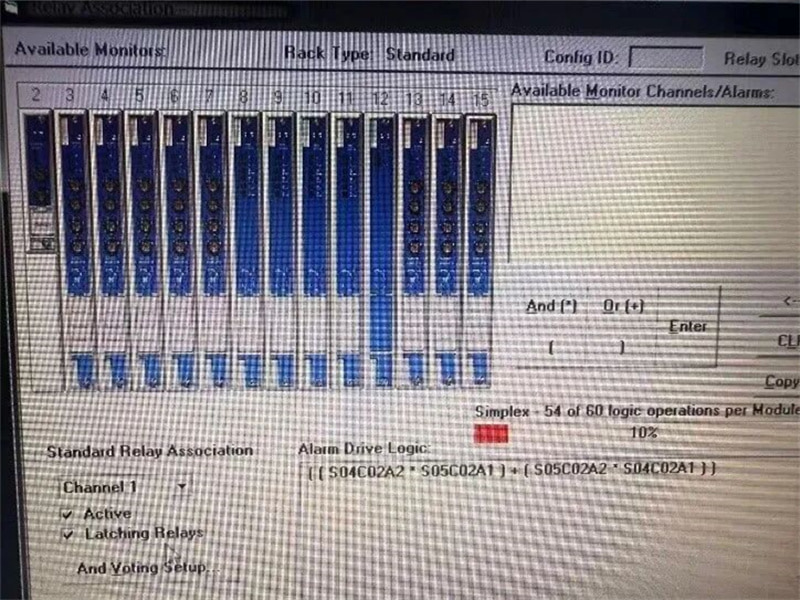
Figure 1: (X Alarm AND Y Trip) OR (X Trip AND Y Alarm) — Trip Output
When the on-site compilation logic was configured, the default "normal AND" setting was utilized, as illustrated in Figure 3. Recently, during routine unit maintenance and fault rectification, the alarm and trip functions associated with "Signal X" were "suppressed"—specifically, the alarm and trip signals for Signal X were bypassed. Following this configuration change, the unit tripped. What, then, triggered this equipment trip?
First, we must understand precisely what "Bypass" entails.
The front panel of the 3500/42M Monitor Module features three indicator lights, one of which is the "Bypass" light. The system defines this indicator as signifying a "Bypass State"—meaning that the system has bypassed one or more alarm or trip setpoints for a specific channel. The Bypass light operates in only two states: "Illuminated" (displaying red) or "Extinguished," as shown in Figure 2.
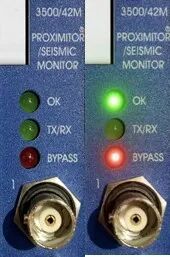
Figure 2: Two States of the Bypass Light
Assuming the system is functioning normally, when the Bypass light is off, all alarms associated with the module are active. During normal unit operation, this light should remain off.
Under what circumstances does the Bypass light illuminate? There are two scenarios that may trigger the Bypass light. The first occurs when a vibration channel is in a "Not OK" state; this condition relates solely to the gap voltage. The second occurs when one or more alarms associated with the module are suppressed. When the "Rack Suppression" function is enabled, the Bypass lights on all cards within the rack will illuminate.
Once the unit is commissioned, under what circumstances might we utilize this "suppression" function?
During the process of troubleshooting and rectifying faults in the field, such "soft switch" functions may be employed to temporarily suppress specific alarm or trip signals. It is important to note that this operation takes effect immediately and does not require a configuration download. Prior to making such settings, instrumentation and control (I&C) personnel must thoroughly assess the risks associated with the internal protection logic while alarms or protection functions are suppressed. The following section presents a specific case study illustrating how a spurious trip occurred following a Bypass configuration, resulting from a misunderstanding of the underlying internal protection logic.
According to the logic diagram (Figure 1) at a specific power plant, once I&C personnel enabled the "suppression" function, the underlying hardware logic of the Bentley Nevada system interpreted the suppressed signal as "excluded" from the logic evaluation. Consequently, the protection logic effectively shifted to: "Alarm Y OR Trip Y" triggers a trip action—meaning that if signal Y reaches its alarm threshold, the unit will trip. Indeed, the unit subsequently tripped in the field because the value on the "Y" side reached its alarm threshold; this incident was classified as a spurious trip.
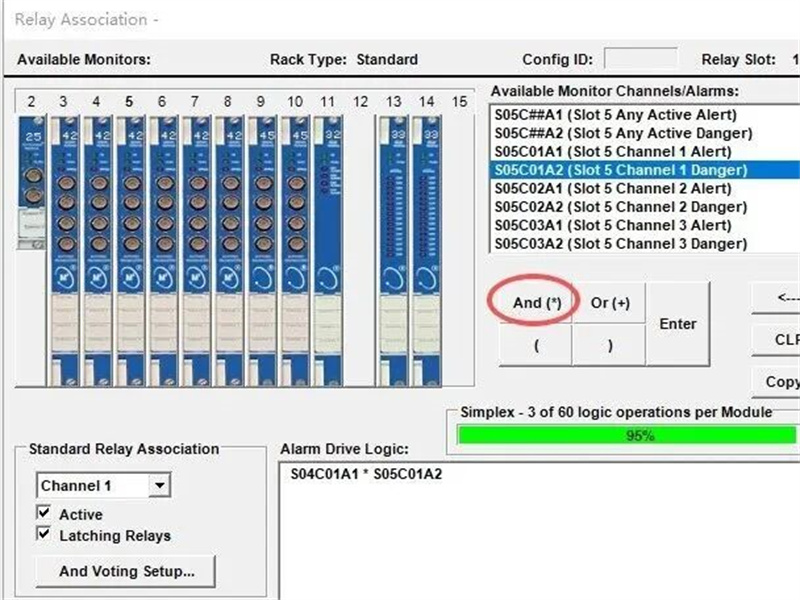
Figure 3: Common "AND" Logic Settings
In fact, the "AND" logic within the Bently 3500/32 card features more advanced settings. To precisely meet the user's specific configuration requirements for the current operating condition, this setting should be adjusted to "True AND," by the implementation of the relevant suppression functions. This is illustrated in Figure 4.
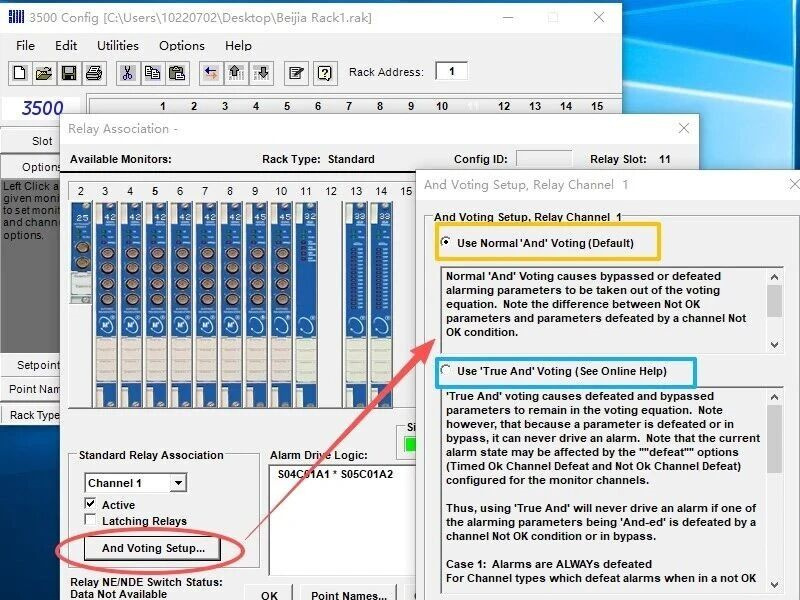
Figure 4: Additional Settings under "AND" Logic
So, under what circumstances might a protection system fail to actuate?
During maintenance inspections of units already in operation, cases have been identified where a failure to actuate—known as a "refusal to trip"—was caused by wiring errors within the power plant's electrical connections. Eddy current probes, extension cables, and preamplifiers are designed to be used as a matched set. In one specific case, a power plant misconnected an extension cable, substituting the required 4-meter cable with an 8-meter one. This resulted in the vibration values reported by the probe being significantly lower than the actual vibration levels. If this attenuated signal were utilized as the input for the alarm logic, a critical risk of a "refusal to trip" would arise during instances of severe unit vibration.
Furthermore, from the perspective of vibration fault diagnosis, severe multi-stage rotor-to-stator rubbing faults typically manifest as a highly flattened elliptical shaft orbit—meaning there is a substantial disparity between the major and minor axes of the vibration ellipse. During measurement by the vibration probes, this phenomenon results in an extremely high vibration reading on one side, while the reading on the opposing side remains relatively low. If the trip logic is configured to trigger a unit shutdown only when "the relative vibration on one side reaches the alarm threshold *and* the other side reaches the trip threshold," such severe rubbing faults may fail to trigger a shutdown. Ultimately, this can lead to equipment damage; in severe instances, localized friction on the main shaft can generate immense heat, causing the shaft to warp or bend.
In summary, regarding the configuration of protection strategies, we recommend an integrated approach that combines theoretical principles with hardware considerations. Users should possess a comprehensive understanding of both the physical structure of the equipment and the underlying logic of the system hardware. During the process of rectifying equipment defects, the internal logic of the protection system should undergo a thorough review to ensure that appropriate settings are established, thereby preventing both "refusals to trip" (failure to actuate) and "false trips" (unintended actuation).
Now please contact with me for best price!!!
| BENTLY NEVADA | 3500/62 163179-03 |
| BENTLY NEVADA | 330130-080-03-05 |
| BENTLY NEVADA | 330400-01-00 |
| BENTLY NEVADA | 9200-09-05-05-00 |
| BENTLY NEVADA | 330881-28-04-050-06-02 |
| BENTLY NEVADA | 330750-80 |
Address : Unit 1904, No.96-2 Lujiang Road, Siming District, Xiamen
Phone/WhatsApp/Skype : +86 18060982349
E-mail : sales6@nseauto.com