Condition monitoring solutions for reciprocating compressors
As one of the oldest compressor designs, reciprocating compressors (recips) enjoy unique capabilities and are quite flexible with features such as broad capacity control ranges and the ability to compress gas regardless of mole weight or k value. Add multiple stages and they can compress a gas to extremely high pressure ratios. Consequently, they are an ideal fit for selected applications—such as hydrogen compression in the de-sulfurization process of many refineries—and as part of the low‑density polyethylene production process in chemical plants.
However, reciprocating compressors suffer from one very serious drawback: high maintenance costs. In fact, compared to similarly sized centrifugals, recips can consume as much as five times the amount in maintenance costs.
That’s why a continuous monitoring system is so important.Specifically designed to meet the unique machinery protection and condition monitoring needs of recips, our solutions, which include safety integrity level (SIL) certified products can help close the gap, bringing your recip maintenance costs closer to the levels associated with centrifugals while simultaneously improving reliability, availability, and safety. And, with patented technology,comprehensive services, and over 55 years of experience monitoring reciprocating compressors, no one is better equipped to help you than Bently Nevada, a Baker Hughes business.
Recip monitoring—in detail

Transducer: 330425 Accelerometer
9. Pressure packing case temperature
Continuous monitoring of pressure packing temperature provides useful information on developing problems related to the packing including excessive wear, insufficient cooling, and inadequate lubrication.
Packing vent line temperature
Continuous monitoring of the vent line provides an indication of leaking pressure packing. With an increase in process flow, the vent line becomes hotter. For years, operators have used the subjective method of touching the line to see if gas is leaking.
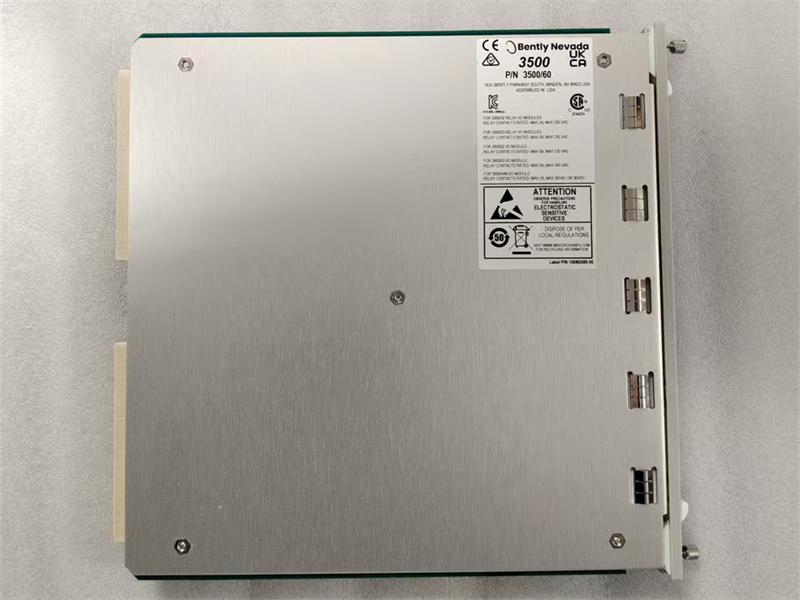
3500 Monitor: 3500/60 or 3500/61 Six-Channel or 3500/65 16-Channel Temperature Monitor
Transducer: RTD or Thermocouple
At the heart of our recip monitoring solution is the Bently Nevada 3500 Series machinery protection system
Integrated machinery protection and machinery management
Our powerful 3500/22M TDI rack interface module eliminates the need for bulky external data acquisition on the hardware or special interface modules between the monitor rack and software. Simply plug an ethernet cable into the 3500/22M rack and you’re ready to communicate with our powerful System 1 software for advanced diagnostics, condition monitoring, and other plant asset management functionality, without interrupting or interfering with machine protection. The result is a zero-footprint solution that simplifies System 1 connectivity for existing machinery protection systems.
And, the enhanced data collection technology of our 3500/22M TDI rack allows earlier and improved diagnosis of previously difficultto-recognize intermittent events (such as cylinder liquid ingestion).
• Fully compliant with the requirements of American Petroleum Institute (API) Standard 670 for machinery protection systems and Standard 618 for reciprocating compressors
• Available in 19 in. 14-slot EIA rack or space-saving 12 in. 7-slot mini‑rack
• Available with a variety of high-quality display options ranging from self-configuring VGA touch screens to remote workstations to LCD panels that mount directly on the rack face
• Digital (Modbus) and analog (4-20 mA) interfaces available for connection to control systems and historians
• Safety integrity level (SIL) certified monitor modules are available for use in functional safety applications
• Six- or 16-channel temperature monitors accept a variety of RTDs or thermocouples. Absolute and differential alarming capabilities allow the monitors to be used for valve temperatures, gas, or other process temperatures, bearing temperatures, crosshead shoe (slipper) temperatures, pressure packing case temperatures, and a variety of other machinery or process temperature measurements
• Capabilities for assessing piston rod vibration and position at precisely defined crank angles for repeatable, useful information on rider band wear, rod bow/ flex, and other conditions. Also applicable to hyper compressors using plungers instead of conventional pistons
• All monitor modules are totally software configurable via the 3500’s rack interface module—key lockable to prevent unauthorized tampering
• Keyphasor module accepts multi-eventper-turn signals for greater accuracy—required for reciprocating compressor applications where crank angle must be precisely determined
• Single-cable ethernet connectivity to our System 1 software for advanced diagnostics and condition monitoring functionality
• Highly reliable power supplies accept worldwide AC/DC voltages/frequencies and can be ordered as fully redundant to ensure uninterrupted performance
• Powerful cylinder chamber pressure measurements now available for the most complete picture of reciprocating compressor health. Dynamic P-V curves, rod reversal measurements, and much more
• Special-purpose four-channel vibration modules are designed to address the casing vibration, crosshead acceleration, and cylinder acceleration measurement requirements unique to reciprocating compressors by providing reliable machinery protection without false or missed alarms. Filtering, alarm delay, full‑scale range, transducer input type, and a host of other options are fully software configurable on a per‑channel basis
• Generic four-channel vibration modules accept velocity, acceleration, and proximity transducers. Filtering, alarm delay, full-scale range, transducer input type, and a host of other options are fully software-configurable on a per-channel basis. Used for a variety of measurements on the recip’s prime mover
• Relay modules allow voting of userconfigurable alarms and health statuses across multiple channels. Relays are highly reliable and intended for connecting the monitoring system to external annunciators and machinery control systems for auto-shutdown
• Fully digital communications of all monitored parameters and statuses using a variety of industry‑standard protocols—ideal for connection to process and machine control systems rather than using analog (4-20 mA) outputs. Supports time‑stamping of alarms and clock synchronization.
Address : Unit 1904, No.96-2 Lujiang Road, Siming District, Xiamen
Phone/WhatsApp/Skype : +86 18060982349
E-mail : sales6@nseauto.com