Tricon Controller Chassis
A Tricon controller can include a maximum of 15 chassis, housing any appropriate combination of input, output, communication, interface, and hot-spare modules. There are three types of chassis: Main, Expansion, and RXM.
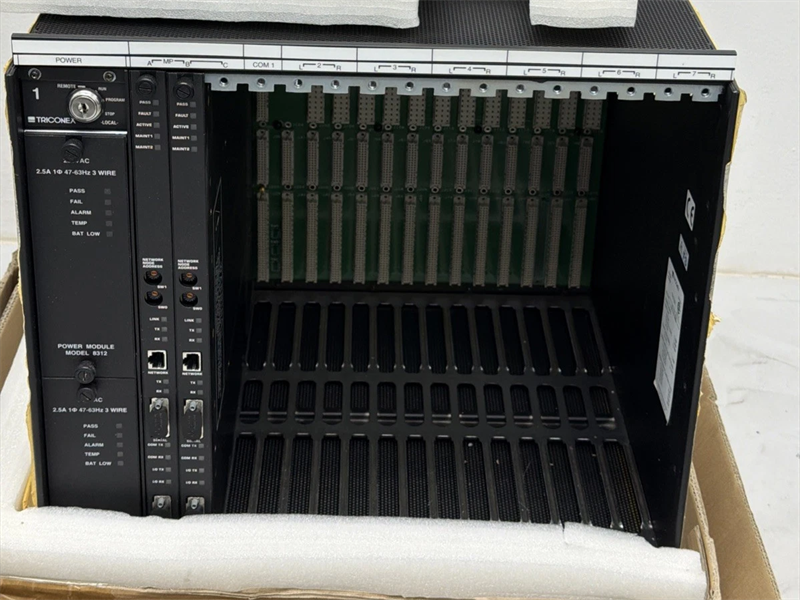
• The Main Chassis houses the Main Processor modules and I/O modules. The Model 8110 Main Chassis houses up to six slot sets of I/O modules and the Model 8120E Enhanced Performance Main Chassis houses up to five sets of I/O modules. The I/O modules in a chassis are connected via I/O expansion bus ports that are triplicated RS- 485 bi-directional communication ports.
• An Expansion Chassis (chassis 2 to 15) houses up to eight slot sets of I/O modules and HART™ Interface Modules. The Expansion Chassis connects to the Main Chassis by means of a triplicated RS-485 bi-directional communication port. Generally, the last Expansion Chassis must be located no more than 100 feet (30 meters) from the Main Chassis or an RXM Chassis.
• An RXM Chassis houses a Primary or Remote RXM Module set and six slot sets of I/O modules. An RXM Chassis enables a system to extend to remote locations up to 7.5 miles (12 kilometers) from the Main Chassis, using SRXM modules.
Main Processor Modules
A Tricon controller contains three Main Processor modules. Each Main Processor controls a separate channel of the system and operates in parallel with the other Main Processors. A dedicated I/O Processor on each Main Processor manages the data exchanged between the Main Processor and the I/O modules. A triplicated I/O bus, located on the chassis backplane, extends from chassis to chassis by means of I/O bus cables.
As each input module is polled, the appropriate channel of the I/O bus transmits new input data to the Main Processor. The input data is assembled into a table in the Main Processor and is stored in memory for use in the voting process.
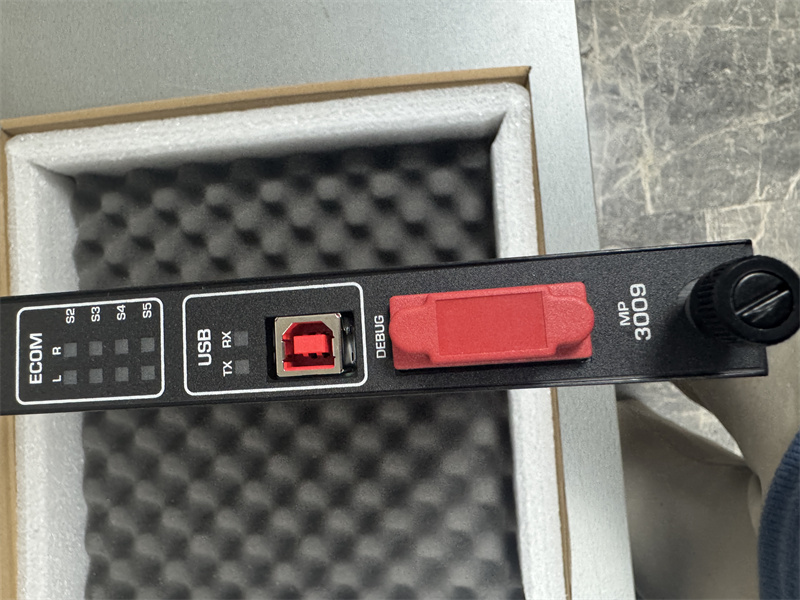
Model 3009 Main Processors
Model 3009 has 256 MB DRAM (without battery backup) and 2 MB NVRAM (SRAM with battery backup).
Model 3008 Main Processors
Model 3008 has 16 megabytes DRAM (without battery backup) and 32 kilobytes SRAM (with battery backup).
Model 3006 and 3007 Main Processors
Models 3006 and 3007 can be used with Tricon v9.0 to v9.5.x systems. They have the same architecture and specifications, except for SRAM, which is 2 megabytes for the 3006 and 1 megabyte for the 3007.
I/O Bus Operation
Each I/O module transfers signals to or from the field through its associated field termination assembly. Two positions in the chassis tie together as one logical slot. Termination cables are tied to panel connectors at the top of the backplane. Each connection extends from the termination module to both active and hot-spare I/O modules, which means both the active module and the hot-spare module receive the same information from the field termination wiring.
The triplicated I/O bus transfers data between the I/O modules and the Main Processors at 375 kilobits per second. The I/O bus is carried along the bottom of the backplane. Each channel of the I/O bus runs between one Main Processor and the corresponding channels on the I/O module. The I/O bus extends between chassis using a set of three I/O bus cables.
Communication Bus Operation
The communication bus runs between the Main Processors and the communication modules at 2 megabits per second.
Power Distribution
Power for the chassis is distributed across two independent power rails and down the center of the backplane. Each module in the chassis draws power from both power rails through dual power regulators. There are four sets of power regulators on each input and output board: one set for each channel (A, B, and C) and one set for the status indicators.
8110 Main Chassis
8111 Expansion Chassis
8310 High-Density Power Module, 120 V
8311 High-Density Power Module, 24 VDC
8312 High-Density Power Module, 230 VAC
3008 Enhanced Main Processor III, 16 Mb
4200 Primary Fiber Optic RXM, Single Module
4210 Primary Fiber Optic SRXM, Single Module
4354 Tricon Communication Module (TCM), Multimode Fiber Optic, Embedded OPC
2870H AO HART Interface, TMR
3501E DI, 115 VAC/VDC, Isolated, Non-commoned, TMR, 32 pts.
3503E DI, 24 VAC/VDC, Commoned in Groups of 8, Self-Test, TMR, 32 pts.
3504E DI, 24 VDC or 48 VDC, TMR, 64 pts.
3511 Pulse Input, Differential, AC Coupled, TMR, 8 pts.
3515 Pulse Totalizer Input, TMR, 32 pts.
3564 DI, 24 VDC, Commoned, Single, 64 pts.
3601E DO, 115 VAC, Non-commoned, TMR, 16 pts.
3603B DO, 120 VDC, Non-commoned, TMR, 16 pts.
3603T DO, 120 VDC, Opto-isolated, Commoned, TMR, 16 pts.
3604E DO, 24 VDC, Opto-isolated, Non-commoned, TMR, 16 pts.
3617E DO, 48 VDC, Supervised, Commoned, TMR, 8 pts.
3624 DO, 24 VDC, Opto-isolated, Commoned, Supervised, TMR, 16 pts.
3625 DO, 24 VDC, Supervised/Non-supervised, Commoned, TMR, 32 pts.
3636T Relay Output, Non-commoned, Simplex, 32 pts.
3700A AI, 0–5 VDC, Non-commoned, TMR, 32 pts.
3704E AI, 0–5 VDC or 0–10 VDC, Commoned, TMR, 64 pts.
3708E Thermocouple Input; Type E, J, K, T; Isolated, TMR, 16 pts.
3806E AO, 6 outputs at 4–20 mA, 2 outputs at 20–320 mA, TMR
3807 AO, Bipolar -60 to 60 mA, TMR, 4 pts.
For more information,please contact with colletplc.com.
Address : Unit 1904, No.96-2 Lujiang Road, Siming District, Xiamen
Phone/WhatsApp/Skype : +86 18060982349
E-mail : sales6@nseauto.com